Sunday, September 10, 2017

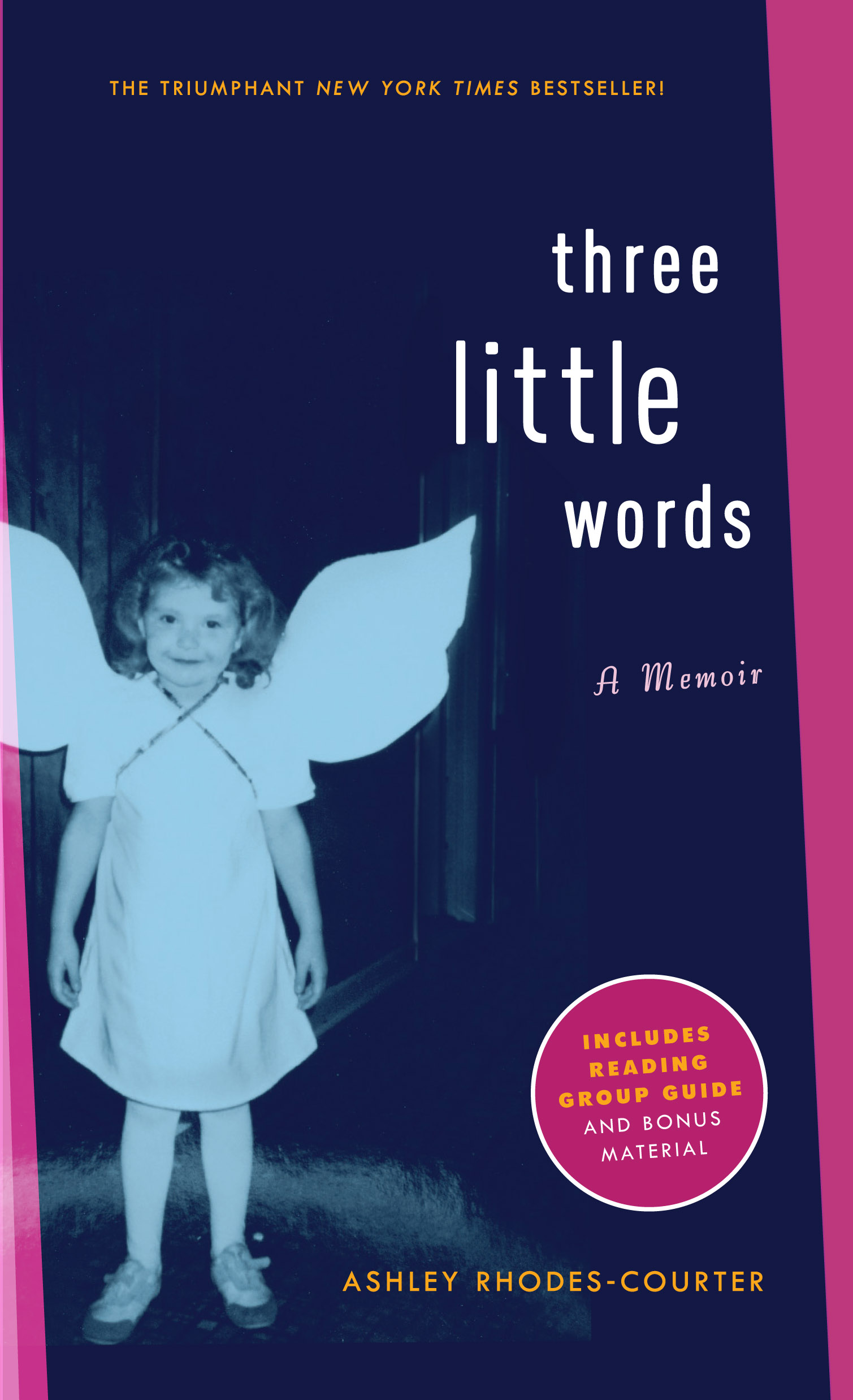
Three Little Words, by Ashley Rhodes-Courter

Image result for three little words book

Three Little Words by Ashley Rhodes-Courter is a memoir (an autobiographical, true, story) of her nine years in foster care, starting from the day the police arrested her mother and placed her and her baby brother, Luke, in the foster care system, and ending a few years after Ashley was finally adopted at the age of 12. In those nine years she lived in fourteen different foster homes. As for the foster parents:   
 "Some were kind, a few were quirky, and one, Marjorie Moss, was as wicked as a fairy-tale witch."
At the Moss foster home, Marjorie Moss abuses the children in her care and then lies about it to the authorities to save her skin. She beats the children, locks them outside, threatens them with a gun, and pours hot sauce down their throats. Some of the kids try to tell what is going on, but nobody believes them. Mrs. Moss is a "model" foster parent, and even teaches classes for other foster parents(!). 

When Ashley grew older, she tried to sue Mrs. Moss and her husband, but once again, they lied so they would be safe. 

To this day, some foster parents still treat foster children like animals or objects, rather than human beings. This book is a first-person account of what happens in some foster homes. Ashley wrote a very detailed description of each foster home she lived in, how the foster parents treated her, and what she kept inside. All Ashley wants is to live with her mother again, but as time progresses, she wonders if her wish to be with her mother will ever come true.

This book is not to be read by children younger than 11 because parts of the book talk about things like molestation, sexual battery, and abuse. Ashley wants the world to know the hardships some foster children must endure, and has succeeded. Today Ashley is a foster mother herself and has cared for more than twenty kids. She gives speeches about the foster-care system and how to protect our nation's children. 

Find out more about Ashley at http://rhodes-courter.com/about-ashley/. Look out for the sequel, Three More Words.

------


Daddy's afterthoughts: This book was one of the recommended titles for Julia's "summer reading" between 6th and 7th grade. This is some pretty heavy stuff for that age bracket. I remember when I was her age the controversy swirling around Judy Blume's books (especially Are You There God, It's Me, Margaret and Deenie), and whether or not they we appropriate for 10-12 year-olds. Those books seem innocent and sweet compared to some of what Ashley is exposed to in some of these homes. For mature tween readers, then, or for tween readers whose parents are ready to have some very grown-up conversations. But for what it's worth, Julia reports that she "loved" this book, and read it through 2 or 3 times before sitting down to write her post. And for what it's worth, this memoir is nowhere near as dark as the pseudo-memoir Go Ask Alice, and has a positive ending and strong message.

Sunday, August 27, 2017

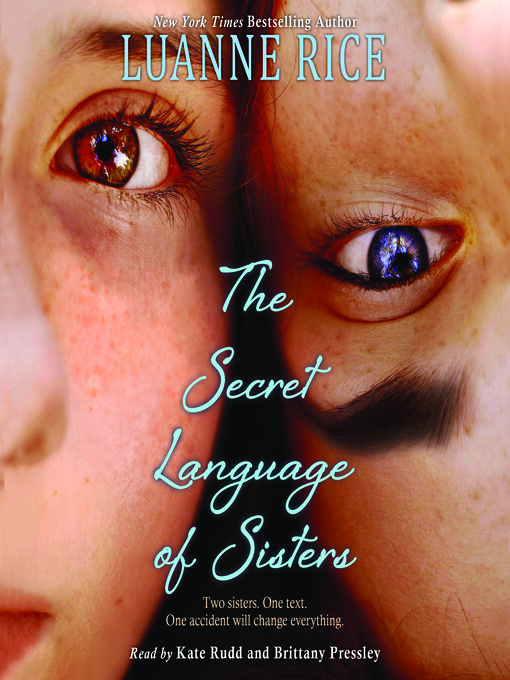
The Secret Language of Sisters, by Luanne Rice

Image result for the secret language of sisters


The Secret Language of Sisters by Luanne Rice is about two teenage sisters, Roo and Tilly. Roo is driving to pick Tilly up from a museum and trying to answer Tilly's texts at the same time, and that only can lead to trouble. Roo looks up from her phone just in time to avoid hitting an old lady, and her car flips over, and is completely destroyed. Roo's body is paralyzed.

Later, while at the hospital, Tilly and her mother visit Roo, and Roo has a stroke right in front of them. The stroke results in locked-in syndrome; Roo can see, hear, and feel everything around her, but she can't move or speak at all. Everyone believes the stroke has caused Roo to be in a coma, and that she is not aware of anything that is going on around her. But this is not the case.

Deep down, Roo believes that she will live through this and someday be able to walk again.

Tilly had always been jealous of Roo. Roo was always the "special" one. She was talented, in all honors classes, and took incredible photographs that got her recognized. Saying that she is "smart" is an understatement. She's a genius. Before the accident, she had planned to apply to Yale University early decision, and was told she'd definitely get in. And she was beautiful. Is beautiful:
 “I don’t want to interrupt,” Newton said. “But can I try something out on you?”
 “Like what?” I asked.
“Well, you and Roo have the same-shaped face, right?”
“Basically. Only hers is gorgeous, with perfect cheekbones, and mine is plain.”
But now, Tilly is only focused on her sister getting better.

However, Tilly battles immense guilt because she feels like she's the one who caused the crash. She doesn't tell anyone (and no one finds Roo’s cell phone at first), so her guilt starts gnawing at her. Not to mention there is an assembly at her school about it and news reporters trying to interview her, making her feel even more guilty. To make things worse, before the crash, Roo had suggested to her boyfriend, Newton, that they put some space between them for a while. But during the time Roo is in the hospital, Tilly starts to develop feelings for Newton. She feels like the worst sister in the world, actually, the “worst person in the world.” 

This book's chapters alternate between Roo and Tilly narrating. I liked this style of narrating. The reader gets multiple sides of the same story, what each sister is thinking. For example, Tilly blames herself for Roo’s accident, but Roo feels differently. But she can’t tell her that… After the crash, there is a long series of surgeries and treatments in hospitals, and it gets so bad at one point that Roo actually believes it would be better if she were dead. But she can’t tell anybody that, either.

This book is probably best for people ages 12 and up, it talks about emotional and scary topics that little kids may find overwhelming, such as a loved one being very, very sick and you not knowing whether or not they will recover or die. The publisher's website says it recommends the book for grades 9 and up (age 13+). But felt like I connected with the characters – I felt like I was right there, on the spot, being one of the characters in the book. When something good happened to them, I felt happy with them. When something tragic happened, I felt sad. I’m only 11 going on 12, so I think any student, middle school and up, could read this.

-------

Daddy's afterthoughts:  I bought this book for Julia at a Scholastic book fair at her elementary school. So apparently somebody thought it was appropriate for a grade 5 or 6 reader. I was actually surprised to see that Scholastic recommends it for only high school level readers.

Julia really connected with this book; that was nice to see. But she came away with the sense that the accident was either Tilly's fault, or that blame was equally shared. In reality - anyone of driving age should know this - the fault lies with the driver. I have read other reviews of this book that criticized the author for doing too little to drive that point home (no pun intended): See for example here, and here. But this is something that is easily ameliorated with a parent conversation after reading.

I am a fan of the switching-narrators technique. This book struck me as kind of an adolescent After-School-Special-Lifetime-Movie-of-the-Week-YA version of Dalton Trumbo's Johnny Got His Gun, a war-protest novel whose chapters alternate between the locked-in thoughts of a blind, deaf, limbless combat casualty in a hospital and flashbacks to the same character's earlier life, when he was young and whole. Haunting. But not for tween readers. Barbara Kingsolver does something similar in The Poisonwood Bible, one of my favorite books, alternating between 4 or 5 (it's been a while, sorry) different characters' points-of-view; like Sisters, one of the characters is mute. A beautiful and mesmerizing read. Also not for tween readers. What's my point? I have no idea. Just wanted to plug two awesome books for the grown-ups out there.


Thursday, August 17, 2017

A Tale Dark & Grimm, by Adam Gidwitz

Image result for a tale dark and grimm


"Once upon a time, fairy tales were awesome." Those are the first words of Adam Gidwitz's A Tale Dark & Grimm, which is the story of Hansel and Gretel mashed up with 8 other fairy tales sprinkled with a little violence. Because Adam means "awesome" in the horrible, bloody way. Warning: This book is not for the faint-hearted.

This book starts before Hansel and Gretel are born. Their father is crowned the King of Grimm, and his servant, "Faithful Johannes," describes to him all the responsibilities of being king and takes him on a tour of the castle. In the last room they visit, the king sees a portrait of a golden princess; he falls in love with her, and faints. When he wakes, he orders his servants to ready a ship. He will go to the island of the golden princess and claim her.

When they arrive at the island where the princess lives, they trick her into boarding the ship, and they sail back with her. Three ravens speak of three dangers the king and princess will encounter when they docked. Johannes overhears the ravens speaking, and heroically saves the couple from the dangers.  But when he explains to the king what he has done and why, he is turned to stone. The king and his new wife put the stone Johannes in their bedroom. Faithful Johannes.

Then Hansel and Gretel are born. This novel is the story of Hansel and Gretel. Actually, eight stories of Hansel and Gretel. They begin like this:

One night the king is in his room with his kids when he collapses at the foot of the statue and starts to cry. When his tears graze the stone, Johannes speaks. He says that to bring him back to life, the king has to cut the heads off his kids and smear the statue with their blood. The king does this…

[WHAT??!!]

…and Johannes comes out of the stone and revives Hansel and Gretel. The king tells his queen what has happened, and she is happy.

[HAPPY??!!]

But Hansel and Gretel hear it all. (Their father cut off their heads, and their mother was glad?) They decide to run away – duh! – and find some decent parents who won’t hurt them.

About a year later, and after a series of sad, bloody, and terrifying events around the kingdom of Grimm – each chapter is a whole new Grimm fairy tale (with Hansel and Gretel stuck in as the main characters) – they learn that a dragon has come to the kingdom. Hansel and Gretel decide to return to, and try to save, their home. Even though, you know, their dad killed them and all…

Have you read the original versions of fairy tales, not the Disney versions? In the Grimms’ “Cinderella,” for example, the stepsisters cut off parts of their feet to fit into the shoe. And at the wedding, where the Prince finally marries Cinderella, the wicked stepsisters’ eyes are pecked out by pigeons.

This book tells these stories the Grimm way.

It’s gory, but there is humor in it. I didn’t find any of it scary or anything. But here’s a tip: tell your mom that this is a book of fairy tales or she may take the book away from you. Besides, you’ll be telling the truth, not lying! Adam Gidwitz wrote this captivating novel in such a way that young readers will be entranced until the very last word.


And look out for the sequels: In a Glass Grimmly, and The Grimm Conclusion!   

--------

Daddy's afterthoughts: I think in an earlier post's Afterthoughts section, I made reference to the glut of authors re-hashing old stories, myths, and fairly tales, and repackaging them as YA novels. I'm not the only one raising a hairy eyebrow at this movement. Elizabeth Bird, writing for School Library Journal, began her review of this same book thus: 
Didn’t want to read this. Nope. Not a jot. Three reasons for that. First off, the title. I’ve said it about twenty times since reading it and every time I can’t quite get it right (derivations have included “Something Dark and Grimm”, “A Grimm Tale”, and “Something Grimm”). Second, the jacket of the hardcover edition of this book isn’t particularly new. Silhouettes against a blue background. Ho hum. Third, I couldn’t believe that I was dealing with yet ANOTHER middle grade novel adapting fairy tales in new ways. After a while the The Sisters Grimm / The Grimm Legacy titles out there begin to meld together. From The Goose Girl to Into the Wild to Sisters Red I sometimes feel as if I am a little tired of fairy tales.
However, to her surprise, she writes, "Gidwitz’s debut is unlike anything I’ve ever encountered before."

Hansel and Gretel wend their way through the landscapes and stolen plot-lines of several lesser-known Grimm tales, like "Faithful Johannes." (Children will not know most of them, and most parents won't either.) This book is fun, and dark. The narrator has kind of a Princess Bride thing going. He pokes, cajoles, goofs. The violence is unflinching, but only really offensive if you are a.) used to Disney's sanitized versions of things, and b.) bound and committed to keeping your children sheltered to that degree. As Bird writes, "The kids are fine with it. It's the parents who can't take it." I have no problem recommending this for ages 10+.

Wednesday, August 9, 2017

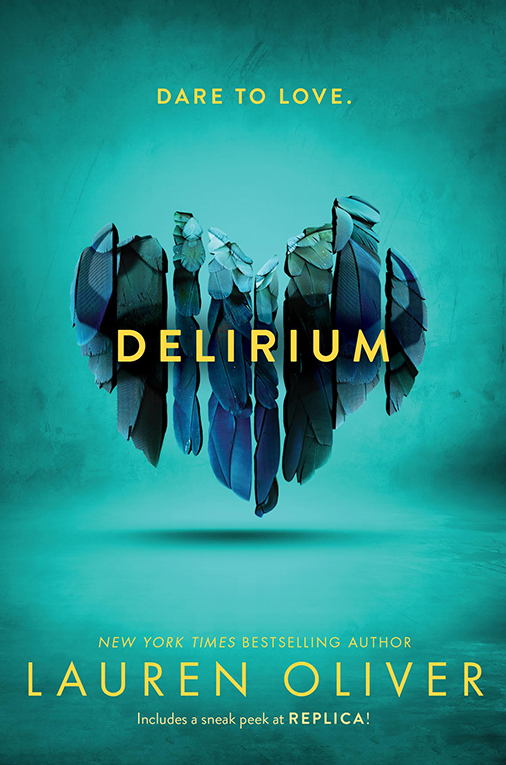
Delirium, by Lauren Oliver


Image result for Delirium book

Delirium by Lauren Oliver is about Lena Haloway and her life in an alternate USA where love has been declared the deadliest disease ever. All people at the age of 18 must undergo a procedure called the Cure. Until then, people are not allowed contact with the opposite gender, for if they do, they may fall in love.

They say, if you get the Cure, you will never feel pain again.

Once cured, people are assigned a college, a major, and a mate. They are not allowed to choose whom they want to marry. They are told how many kids to have, and given a job for life. They believe that love truly is a disease, and being cured, everything will be all right. Once cured, their lives are set on a track and all planned out; they don't have to worry about what will happen to them. They are safe. The people all end up happy.

Except Lena's mother.  

The government scientists tried to administer the Cure three times, but it never worked. But before they could try a fourth time, Lena's mother killed herself. Her last words to Lena: "I love you. Remember. They cannot take it." 

Lena is looking forward to the time when she receives the Cure. She won't feel the pain that she feels when she thinks about her mother; it will disappear. She will be "safe, free from pain." 

Until she meets Alex, a boy about her age. They start spending time together more and more often. What will happen to them if they fall in love? This would be forbidden. The government controls what everyone does. The people don't get to choose their own path; it is chosen for them. It is laid out in a nice neat line, no curves. And they are happy this way, mostly. 

But this is not okay, is it? The government is stripping people of a basic right: the power to choose -- to choose how they want their lives to be, to even choose how they feel. It's perfectly fine for the government to want everybody to feel safe and happy, but by stripping away basic rights and freedoms -- that's not right, is it? Even if most of the citizens do feel more relaxed and happy and safe?

Lena's friend Hana says that in order to be truly happy, maybe you have to be unhappy sometimes. And Alex is a resister, and an "Invalid," someone who lives out in the Wilds, avoiding the law. But Lena is looking forward to her Cure; will they persuade her to change her mind?

This book is kind of like The Hunger Games, with a corrupt government trying to control everything that people do. Both books' heroines are female teenagers of about the same age. There is one big difference, however -- In The Hunger Games, everybody (except the citizens in the Capitol) knows that the Reaping and the Games are terrible, and an injustice. In Delirium, most people agree with the government and are okay with the Cure. Even Lena is excited about getting her Cure soon. At first.

Delirium is about love, but it is also about standing up for what is important to you.
 

This book is long (over 440 pages) and the characters use a lot of swear words; this book is not for younger readers. It is a little more mature than The Hunger Games; there is less violence in this book, but the plot is harder to grasp. Middle school students and up will enjoy this, especially if they liked The Hunger Games.

------

Daddy's afterthoughts:  Julia does not know the word "dystopia," so I'll supply it. This book (actually, the first book of a short series) is an excellent entry into the canon of YA dystopian fiction. It bears some resemblances to the aforementioned Hunger Games series, as well as the Divergent trilogy. It bears thematic similarity to Lois Lowry's The Giver, which many students will read in 7th, 8th, or 9th grade, as well as Kurt Vonnegut, Jr.'s short story "Harrison Bergeron," Ayn Rand's Anthem, and the dystopian novel supreme, 1984. (I do NOT recommend 1984 for 11 to 13 year-olds, though The Giver and Anthem are very readable by junior high school readers).

Tuesday, August 1, 2017

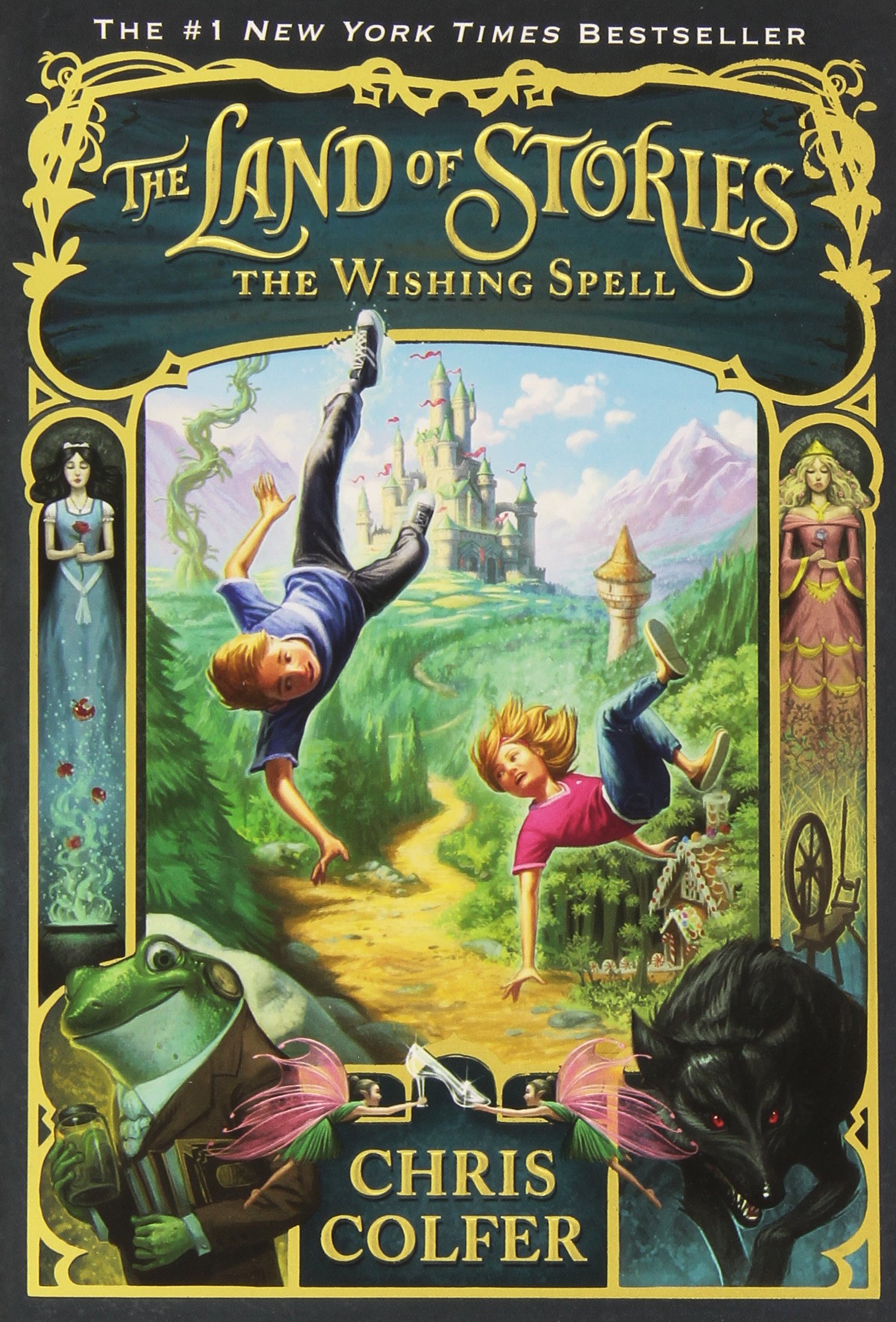
The Land of Stories: The Wishing Spell, by Chris Colfer

Image result for the wishing spell


The Land of Stories by Chris Colfer is about the Bailey twins, Alex and Conner, who, even though they're twins, couldn't be more different. Alex is an exceptionally smart, kind, and caring girl, while Conner constantly falls asleep in class. They live with their mother in a small rental house, their mother struggling with money after the twins' father died in a car crash. They lived a simple life, until the twins' 12th birthday. Their grandmother surprises them with a few presents, and a huge dinner she cooked. Then she pulls out one last thing. A storybook titled The Land of Stories, a book that has been a big part of their childhood - a book that their grandmother read to them whenever they had visited:
"She returned carrying a large, old book with a dark emerald cover titled The Land of Stories in gold writing. Alex and Conner knew what the book was as soon as they saw it. If their childhood could be symbolized by an object, it was this book" (59). 
Later that night, Alex goes to bed like normal, when all of a sudden, the book's pages start to glow. Alex finds out that you can actually drop things into the book. When it would start to glow, Alex would put something on the pages and it would slowly sink into the book and disappear! 

Alex wonders what it would feel like if she put her hand into the book? So, one day, Alex puts her hand on the open book's pages. Like the other objects, it slowly sinks in. Alex keeps on going until her entire arm is in the book. Conner thinks that Alex is actually going to try to go into the The Land of Stories after she tells him that things can go in the book. So, while Alex has her arm in the book, Conner barges in to try to stop her, startling Alex, causing to fall over, headfirst into the book. Conner jumps in after her, and they become trapped in The Land of Stories

The twins start walking around, looking for a way home, and instead find a talking frog-man, who Conner calls "Froggy." He tells them about the Wishing Spell, a magical spell that grants the user one wish. Alex and Conner decide to use this spell to get home. They have to collect a series of items, and grouping them together activates the spell. However, the Wishing Spell can only be used twice; Froggy tells them that it has been used once before (by who, I wonder?). 

If that isn't enough, these items mostly belong to the monarchs of the fairy-tale world and the Evil Queen has escaped from the dungeons of Queen Snow White's palace and are after the same things that Alex and Conner are after. What could go wrong?

Do Alex and Conner manage to avoid the Evil Queen and get home safely? This story is about a pair of intelligent, brave (or completely insane) children weaved in with the lives of classic fairy-tale characters (Snow White, Red Riding Hood, Goldilocks) as adults. The twins will face the Big Bad Wolf's descendants, escape being eaten alive by a witch and (accidentally) start a fire in Queen Red Riding Hood's castle in this thrilling novel!

And be sure to check out the 5 other books in this series: The Enchantress Returns; A Grimm Warning; Beyond The Kingdoms; An Author's Odyssey; and Worlds Collide!      

-----

Daddy's afterthoughts:  So, a friend of mine messaged me that Julia's blog had made the front page of Reddit. Wow. Thank everyone so much for blowing my daughter's mind! The response has been (mostly) positive! Julia is beaming with pride and happiness! I read the comments, and wanted to address a few things, however...

No, Julia is not an "aspiring mommy blogger" masquerading as an 11-year-old girl. Yes, she and I co-blog, in that I review and give comments on her blog post rough drafts and then she revises them (sometimes more than once, as need be). Earlier blog posts have more of my influence, later blog posts are Julia weaned from my "helicoptering." (This post, for example, was all her, minus a few verb tense issues.) Lastly, I am a teacher, and so my "Daddy's afterthoughts" section is geared towards the parents of young readers. I try to avoid what one redditor called "pretentious intellectualising," but I suppose you can't please everybody.

Please continue to enjoy the blog! Thank you for your support and your comments, and
please feel free to follow or leave comments!


Wednesday, July 26, 2017

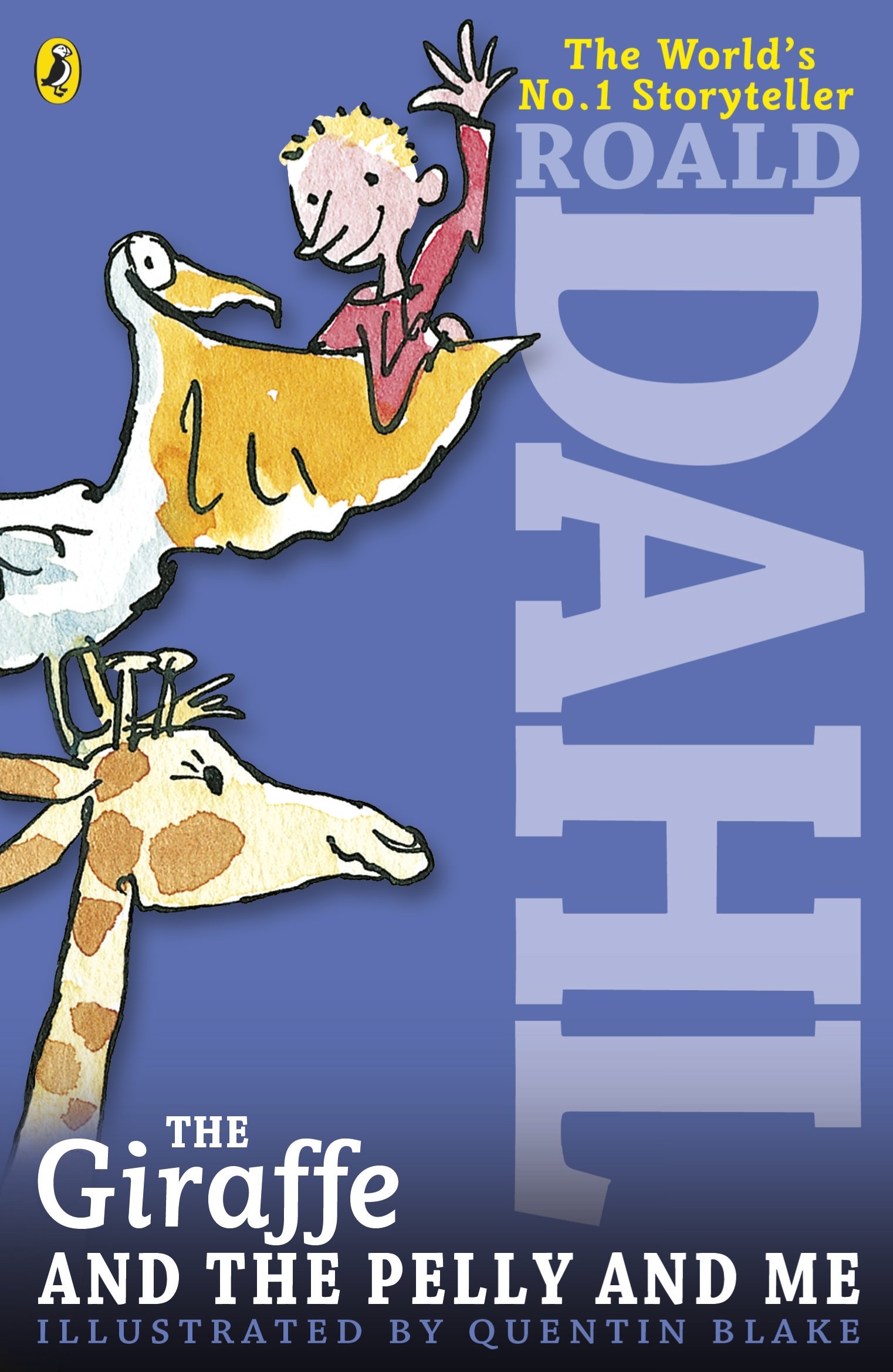
The Giraffe and the Pelly and Me, by Roald Dahl


Image result for the giraffe and the pelly and me

The Giraffe And The Pelly And Me by Roald Dahl (Yes, the Charlie and the Chocolate Factory Roald Dahl) is a hilarious and short book about a Giraffe, a Pelican, a Monkey, The Duke of Hampshire, and a young boy named Billy, the narrator of this story.

Billy dreams of owning a marvelous sweet-shop. There is an old building by his house called "The Grubber", with the words FOR SAIL on the window. (In the old days, a grubber was a name for a sweet-shop.) Billy wants to turn it back into a wonderful sweet-shop again. One day, Billy sees that the words FOR SAIL have been scraped away and in its place someone has painted SOLED. Then pieces of the inside of the building start flying out the window, as if someone were inside the building, ripping things apart and chucking them out. 

The next morning, Billy is back at "The Grubber" and the first thing he notices is a new door. It would be really hard not to spot it because it was a.) red, and b.) twice as tall as the old one. The writing on the window has changed yet again, and this time it said: 

The Ladderless 
Window-Cleaning 
Company ~
Get your windows 
cleaned without 
a lot of dirty 
ladders leaning
against your 
house.

Suddenly, a strange head appears out of a window on the top floor. Billy had no idea who or what it belonged to, at first. Then another window opened and a Pelican landed on the windowsill! The Pelican ("the Pelly") introduces Billy to the Giraffe, the owner of the head he saw. Then, on the first floor, another window flings open and a monkey pops out! 

They are the window cleaners, and each of them can do a special thing. Pelican can retract the top of his beak and turn his lower beak into a huge bucket (for water) without his top beak getting in the way. See the picture above! Giraffe can stretch her neck to an amazing height (like a ladder), and Monkey can climb up her neck (like climbing a tree) to wash windows on the upper floors of a building.

Oh, and all three of the animals can talk.

After a little chit-chat, the window cleaners receive a letter from The Duke of Hampshire, the richest man in England, asking them to clean all 677 windows of his house. So in a short while, they arrive at the Hampshire House (Billy has to show them the way there.) Billy and the window-cleaners introduce themselves to The Duke of Hampshire. The animals appoint Billy as their official business manager (they don't know any other humans) and they get to work.

Is the Duke of Hampshire freaked out by the fact that his window-washers are talking animals? How long does it take to clean 677 windows? Does Billy ever get to own the sweet-shop that he's dreamed of for so long? (Managing a window-washing company is an odd career choice...) And what is Roald Dahl's favorite smell? (Answer: Bacon frying. Yes, it's in the book...)

This book is great for anyone who loves a short, funny story that never gets boring. The book is only around 70 pages, and has loads of illustrations that made the reading even more fun. I hope that everyone who reads this book loves it. And be sure to check out all the other books by Roald Dahl!

-------


Daddy's afterthoughts:  Some parents may be worried by Dahl's reputation as being antisemitic in his personal views, but I don't know if that should color anyone's consumption of or enjoyment of his works of fiction, and I don't see that it actually affected his writing. (But where parents are making choices for their children, forewarned is forearmed, and trigger warnings are all the rage these days.) All that said, this is a deliriously silly and wonderful book, and I just recently learned that there is an audiobook out there voiced by none other then Hugh Laurie (of House fame)!!! Hear a snippet here.


Monday, July 17, 2017

The Girl Who Could Fly, by Victoria Forester


Image result for the girl who could fly
                                                                                                                         
The Girl Who Could Fly by Victoria Forester is about a 9-year-old girl named Piper McCloud who was born with a natural ability to float. Piper lives on a small farm with her ma and pa in a small town called Lowland County. Piper is sitting in a tree observing a robin's nest, when the mother robin pushes one of her babies out of the nest. But before hitting the ground, the baby bird starts to fly. Piper decides that she should learn how to fly too. She teaches herself how to fly by:
  1. Standing perfectly still. 
  2. Thinking “I’m as light as a cloud, as free as a bird. I’m part of the sky and I can fly.” And thinking that for a very long time, while thinking nothing else.

Piper's flying attracts the attention of Dr. Letitia Hellion, director of an institute called I.N.S.A.N.E., and she asks Piper if she would like to come to the institute. She says that at the institute, Piper will be protected from other people who would want to "get" at her, or hurt her in some way, because they may think she is dangerous. Piper and her parents agree, believing going to the Institute would be for Piper's own good.

Once at the site, Piper meets the 13 other residents, all with special "talents" like hers. For example, two of the residents, the Mustafa twins, can control the weather. Also, there's Lily Yakimoto, who is telekinetic. Another girl can control electricity, and there is a boy with X-ray vision. Eventually, she befriends Conrad who is extraordinarily smart. He has figured out how to time travel, and he is “15 times smarter than Einstein.” He claims to know the true nature of I.N.S.A.N.E., and if he's right, it isn't good.

Personally, this book reminds me of Harry Potter, kids being sent off to a special school and whatnot. So, readers and watchers of Harry Potter may like this book. Piper is a caring, stubborn girl who, once she sets her mind to do something, won't stop until she's achieved what she wants to do. This picturesque story will grab every ounce of your attention and will not let go until you've flipped the last page.

 ________

Daddy's afterthoughts:  I have not read this particular one, but Julia really likes it. This is yet another book with a plucky female heroine on a quest to find, resolve, or restore something; she seems to gravitate towards those. The notion of the school/institute for the special/different/gifted/touched seems to have manifested itself an awful lot in this past generation:  Harry Potter is perhaps the most obvious. (By the way, for an interesting look at books that may or may not have been literary/plot antecedents for Potter, and a host of ideas of other things to read/watch, check out this article.) But also the X-Men (which, to be fair, have their origin in the 1960s), aspects of the plots of various seasons of Marvel's Agents of S.H.I.E.L.D., Miss Peregrine's Home for Peculiar Children (the books, not the slightly-better-than-so-so film), and a host of other books for readers in grades 3-8 featuring children who go to magical schools, supernatural schools, fairy tale schools, or princess schools.


Tuesday, July 11, 2017

Every Thing on It, by Shel Silverstein


Image result for everything on it

Image result for years from now by shel silverstein
That is the first poem of Shel Silverstein's Everything On It, a book of funny, easy-to read poems about mostly random topics, from a hot dog with everything on it (Hmm, that sounds familiar) to 28 uses for spaghetti.

I particularly loved this book because of the funny poems.  My two favorite poems in this book are "The One who Invented Trick-or-Treat," a poem spoken by a dentist who claims that he invented trick-or-treating to make more money, and "The Lovetobutcants," about a person trying to make up excuses for not having to do any work or chores. Another poem I like, "Growing Down," is about a grumpy old man called Grow-Up Brown who is always telling children to grow up and act more mature. One day, the children suggest to him that he should try growing "down" instead, and act more like a child. So he does it for a while. And what do you think happens?

When Shel Silverstein wrote this book, he too was "growing down." I believe that when he writes poems like these, he feels like a child again. He wants to share that feeling of being young again with his adult and teenage readers. However, this book is appropriate for anyone because it has no rude humor and has no challenging words, making it ideal for younger kids as well as adults. This book can help introduce children to the world of poetry. They probably think poetry is all boring and about love and all that. But that's not (necessarily) the case at all. After reading this book children may ask for more poetry books, or even feel inspired to write their own poems. I can guarantee that anyone who reads this book will love it.

And keep an eye out for his other poetry books, including Where the Sidewalk Ends, Runny Babbit, Falling Up, and A Light in the Attic!


-------

Daddy's afterthoughts:  When I was about Julia's age, or perhaps slightly younger, I saw a stage presentation of dramatized readings of Shel Silverstein poems. I was hooked, so as soon as my kids were old enough to read poetry (and to not destroy expensive hardcover books) I started buying them one Silverstein hardcover per year for the holidays, and still have a few left to go. If your kids like Silverstein, then for sure hunt down Ogden Nash's poetry, or Roald Dahl's Revolting Rhymes, and if you're lucky you'll stumble across a hard-to-find book called O Sliver of Liver by Myra Cohn Livingston. More adventurous young readers of fantastical poetry will thrill to Nancy Willard's Newberry Medal and Caldecott Honor-winning book A Visit to William Blake's Inn: Poems for Innocent and Experienced Travelers.


Friday, June 30, 2017

A Proud Taste for Scarlet and Miniver, by E. L. Konigsburg

A Proud Taste for Scarlet and Miniver by E.L. Konigsburg


A Proud Taste for Scarlet and Miniver by E. L. Konigsburg tells the reader the life of Eleanor, Duchess of Aquitaine, as well as Queen of England and former Queen of France. (Yes, she was both, in real life!)
 

Eleanor is waiting in Heaven (after spending two centuries in Hell) for her second husband, Henry II of England. Why Hell?
"After she had died, and before she had arrived in Heaven, it had been necessary for Eleanor to learn some patience. Heaven wouldn't allow her Up until she had" (p. 3).
Her life story is told by three people in Heaven, whom in life Eleanor had been very close to: Abbot Suger (a priest), Eleanor’s mother-in-law Matilda (an empress, King Henry's mother), and William the Marshal (a knight). The last part of the book, the 15 years after Henry's death, is told by Eleanor herself.

They are all waiting together to see if Henry will be joining them up in Heaven. They have been waiting for about eight centuries (Eleanor, for six), because Henry is still awaiting judgment in Hell. While Eleanor and the others are waiting, they retell Eleanor’s life story, starting from when she married King Louis of France.

Eleanor of Aquitaine is a phenomenal woman, but she has very little patience. I mean, anybody who was waiting for eight centuries would have very little patience indeed! I know for a fact that if my mom were waiting for my dad to get home from work for too long, she would be calling him, texting him, and when he finally did get home she would present him with a list of everything that she needed to get done.
 

This book is appropriate for readers ages 12 and up, because many younger readers will not understand the the way it is written. The vocabulary isn't too hard, but the dialogue is formal, proper, and old-fashioned. It is written to be funny, but I didn't get many of the jokes (and I am 11). I think that if I understood some of the humor, I would enjoy it a lot more. There are also a lot of historical people, places, and events to remember. Their dialogue has a lot of religious content (talking about Heaven, God, Hell, etc.) that some people may find offensive. They also talk a lot about politics and war. It's not exactly your everyday dinnertime conversation, and this is not a conversation between school-aged friends.
 

I will definitely try reading the book again when I am a little older, though!


------

Daddy's (long) afterthoughts:  Julia struggled a bit with this book, but I think I know why. First of all, let me get this out of the way: Parents, this is a phenomenal book. And it is pretty darn funny. For the right audience. However, the style in which it is written is a touch on the "yesteryear" side. The discourse is much more Downton Abbey than Real Housewives. The wit is erudite, and to a certain extent presupposes some awareness of historical context. And the topics of discussion are rather mature. A couple of examples:
        Henry dismounted from his horse to sleep, to eat, and to pray, but for little else.
       "Henry," Eleanor said, "the children think their father is a centaur." 
        Henry got down on all fours and chased his sons [...] "A centaur is a pagan invention," Henry said to them. "Half man, half horse. I am all Christian and all king," he said.
       "Only the king part is divided," added Eleanor. "It is half English, half French."

       William of Aquitaine wanted his daughter Eleanor wed to the king's son, Prince Louis. With Eleanor would come her lands. With Louis would come a title. A good marriage. A marriage of pomp and pocketbook. William of Aquitaine knew that King Louis could not pass up a bargain.
My kids grew up reading Magic Tree House books (nothing wrong with those - both of my kids loved them) and other books written to accommodate the language as it is used today. Julia read the Diary of a Wimpy Kid books, and really enjoyed the Whatever After series. She loves Roald Dahl, loves Rick Riordan, and loves the poetry of Shel Silverstein. She is and has been what I would describe as a voracious reader, but she has scarcely taken the time (and I have not pushed the issue, which I regret a bit) to read some of yesteryear's modern classics, with their more leisurely pace, wandering dialogue, and elevated vocabulary that stubbornly declines to speak down to children as if the author assumes they can't handle it.

In Julia's case, she has (slightly abridged versions of) the so-called children's classics (Little Women, Heidi, Black Beauty, Treasure Island, etc...) but she rarely wanted to read them, occasionally starting them but putting them down due to lack of interest. And when we tried to read the Chronicles of Narnia together, she was put off by C.S. Lewis's style, wordiness, and constant digressions and asides. Following the Stephen Krashen-inspired notion that any reading is good reading, and more reading is better than less reading
(see "Junk Food is Bad for You But Junk Reading Is Good for You"), she read a lot, with my wife's and my blessing: 10, 15 hours a week, by choice, and we bought her pretty much what she wanted, book-wise, as long as its "lexile" was not below where we thought was too low. And so she read Judy Blume, read Jacqueline Davies, read Raina Telgmeier's graphic novels. She read Calvin and HobbesDiary of a Wimpy Kid, the Who Was? biographies and What Was? histories, and Lauren Tarshis's I Survived historical dramatizations

But in retrospect, I can see why she (indeed many young readers these days) has some difficulty with denser narration, elevated vocabulary, baroque and florid style. So much of children's and YA fiction these days loves story so much more than it loves language that I suspect this is a widespread, generational phenomenon. In theory, a 6th or 7th grade reader should be able to enjoy and appreciate this book (even if they don't get everything), but I suspect that, for many modern kids, it might have to be an 8th, 9th or 10th grader.

Monday, June 19, 2017

Serafina and the Black Cloak, by Robert Beatty


The story takes place in 1899 in a mansion called Biltmore Estate in North Carolina. Serafina is a 12-year-old girl who lives with her pa in the basement of Biltmore Estate. Serafina is an unusual little girl; she is “different” – she has only four toes on each foot, and amber-colored eyes like a cat. One night, she hears what sounds like a child being dragged around. She has excellent senses so she is easily able to find the room where this is happening, and watches, horror stricken, as the child is literally absorbed by the folds of a man’s black cloak.

Serafina tells her pa about the Man in the Black Cloak and how the cloak consumed a little girl. Sadly, her pa does not seem to believe her. She feels that her pa doesn’t care about her after he just goes back to work as if the conversation has never happened. Serafina is upset. She walks away, and as she passes the stairs, she feels an urge to climb them. She knows that she’s not supposed to be seen (no one knows that she and her pa are secretly living in the basement), but she has snuck around before without being caught.

Serafina walks up the stairs and into a large room with a piano where several people are gathered, doing her best to remain hidden. But soon she hears someone ask “Are you lost?” She whips around, hissing, and stops when she sees who it is. It is the young master, Braeden Vanderbilt, teenage nephew to Mr. and Mrs. Vanderbilt, the owners of the estate. He is her age, so she trusts him. They develop a friendship, and Serafina tells him about what she saw. Braeden tells her that this isn’t the first time a child has disappeared.

Serafina and Braeden embark on a series of thrilling adventures full of danger in which they try to unravel the mystery of the Man in the Black Cloak, who returns to the estate again and again in search of children to snatch. This becomes more complicated when it appears that the man in the cloak particularly wants Braeden!

This book is for people who love mysteries, ages 9 and up. It is not a difficult read, but at almost 300 pages, it is probably not for really young readers. It has an intriguing plot and a clever pair of young heroes. Also, it has a setting that actually exists in the real world: Biltmore Estate in North Carolina is a real place, built by the real Vanderbilts in the Blue Ridge Mountains. Some of the characters are made up (like Serafina) while others are real people (like Mr. Vanderbilt). And at the end of the story, readers realize why it is that Serafina is so “different.”

I sincerely hope anyone who reads this book will love it, and definitely check out the book’s sequel, Serafina and the Twisted Staff.

------

Daddy's afterthoughts: This is a mystery-thriller, and while I love stories that interweave shards of reality with fiction, I should point out what Common Sense Media says about the book: "This scary story is not for the faint of heart; the abduction scenes are graphic as children scream out in terror and seemingly vanish into the foul-smelling cloak. Serafina and Braeden are often under attack from the man in the cloak and other supernatural beings." So there you go. However, in the same breath that they give the story a 5/5 for "violence and scariness," they also give it full marks for "positive role models" and "positive messages." FWIW, Julia is a touch on the squeamish side, but she was not only fine with the book, but loved it. It is, I suppose, no darker than much of what happens in the Harry Potter stories.


ABOUT MY BLOG

WELCOME to my blog about books I have read, and books I recommend.

If you are looking for books in the age range of 9-16 (grades 4-10), then maybe I can help you decide which book to read! If you are a stude...